EasyMarker video positioning system
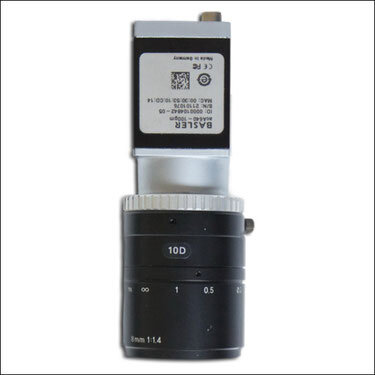
Professional video system with a Basler GigE industrial camera and a licence for image processing, which enables automatic recognition of fiducial marks required for precise adjustments during contour cutting and milling work.
The system makes it possible to automatically adapt the design to the workpiece at hand by automatically recognising and measuring previously applied or printed fiducials. The data obtained is used to automatically adjust the work paths on the workpiece.
How the EasyMarker video positioning system works:
A practical example
In order to be able to cut or mill out printed motifs from a plate with exact contours, the plate with the print must be precisely aligned and a zero point must be determined with great effort. Even in the ideal case, several test runs would be necessary, and often an unnecessarily thick edge is left.
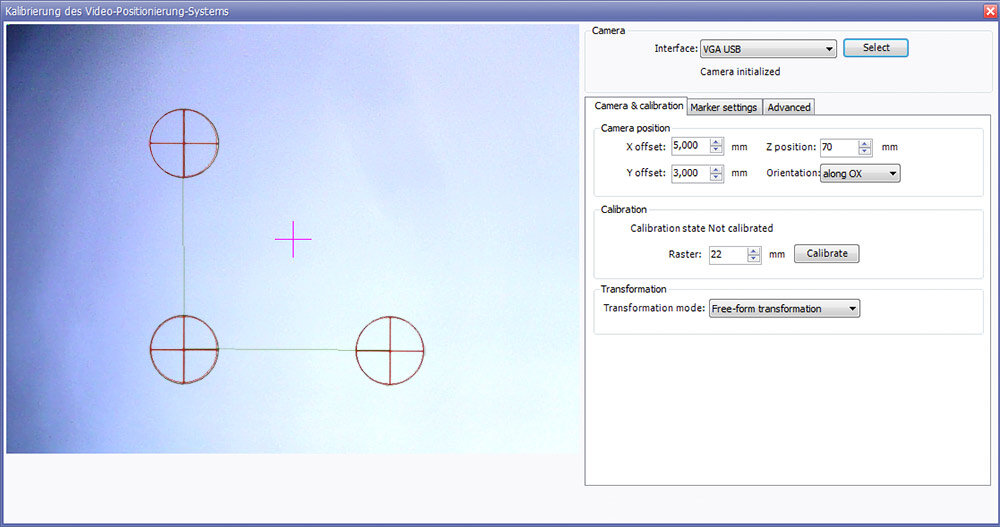
Our camera system avoids this problem by recognising registration marks previously printed around the subject and comparing them with the working paths of the drawing. The drawing is then adjusted based on the differences detected: rotated, shifted and, if necessary, scaled.
The system is seamlessly integrated as a plug-in into cncGraF Pro and allows permanent mounting next to the Z-axis by defining an offset between the camera and Z-axis position. It is ideal for digital print shops, packaging design, sign and advertising production, as well as fabric cutting for flag and banner production using milling tools, oscillating tangential knives and lasers.
Precision and repeatability
The positioning and repeat accuracy of the EasyMarker system is largely determined by the camera resolution, the optics and the alignment of the camera.
In a typical configuration with a camera resolution of 640 × 480 pixels and a visible working field of approx. 50 × 37.5 mm, 1 pixel corresponds to around 0.078 mm. This means that even an offset of just one pixel corresponds to a deviation of less than 0.1 mm.
A higher camera resolution or a lower working distance to the material can further increase accuracy - ideal for applications that require maximum precision.
 EasyMarker video positioning system - Quick guide (ENG)