The postprocessor and the importance of G-code in CNC machining
In the world of CNC machining, the generation and use of G-code is a central part of the process.
In this blog article, we delve into the world of G-code, shed light on its history and explain the role of post-processors (PP for short) in CNC machining. You will also learn how our CNC control software, cncGraF, fits into this picture. Join us on this journey of discovery!
CNC (Computerised Numerical Control) machines revolutionised the manufacturing industry by enabling automated tool movements. They were originally developed by the Massachusetts Institute of Technology (MIT) in the 1950s. The G-code, also known as DIN66025, established itself as the universal standard for controlling the motion sequences of these machines. The introduction of this standard was a decisive step towards making CNC machining processes efficient and repeatable.
Overview
How were the G-code files generated in the past?
Before computer-aided technologies such as CAD (Computer-Aided Design) and CAM (Computer-Aided Manufacturing) existed, G-code was written manually by machine operators. G-code is an ASCII file containing simple commands such as „move to a position G01 X10 Y10“ or „switch on the spindle with M03“. Programming was carried out directly on the CNC system or in a text editor.
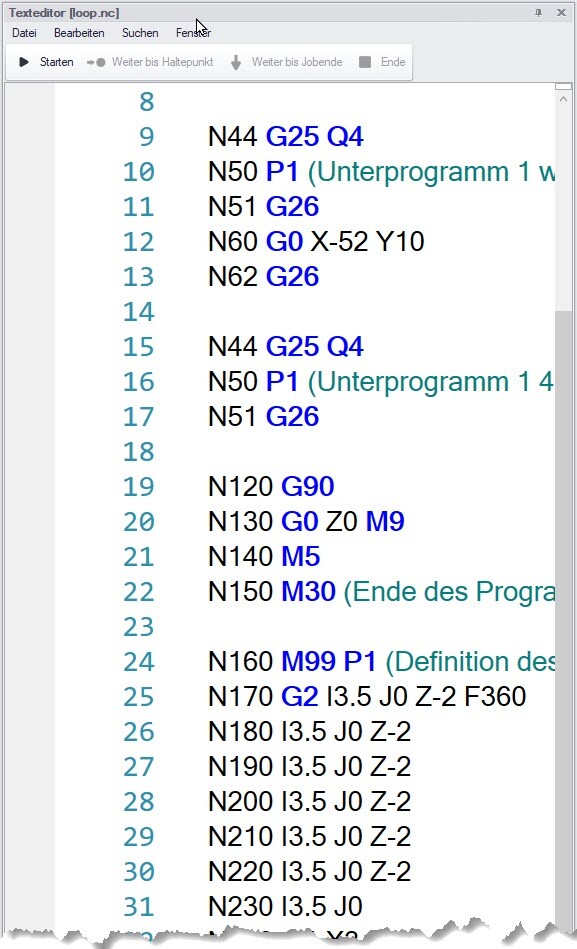
The machine operators required in-depth knowledge of the G-code standard, the machine specifications and the materials to be processed. Creating such codes was time-consuming and required careful checking to avoid errors.
Today, G-code is generated using CAD/CAM software
Modern CAD/CAM software has revolutionised the process of G-code creation. These programmes make it possible to design parts and simultaneously generate the necessary G-code to implement these designs on CNC machines.
The advantages of this development are:
- Time efficiency: Automated G-code generation saves time.
- Error reduction: Automatic generation minimises human error.
- Flexibility: Design adjustments can be quickly implemented in the G-code.
- Optimisation: Modern software makes it possible to optimise the processing path in order to save material and time.
- Complexity: CAD/CAM software can be used to generate highly complex projects and geometries that would be almost impossible to realise manually. This has opened up new and advanced design possibilities that were previously unattainable.
What are postprocessors and why are they needed?
Even though G-code is a universal standard, different CNC machine manufacturers often have specific requirements and peculiarities. A post-processor (PP for short) acts as a translator between the CAD/CAM software and the specific CNC machine. The postprocessor receives the generic G-code and adapts it to the specific requirements and capabilities of the machine. This ensures that the G-code is executed correctly, regardless of the machine used.
 Hinweis: Die CNC-Steuerungssoftware cncGraF unterstützt Standard-G-Code. Deshalb sollte es keine Probleme geben, einen passenden G-Code zu generieren.
Prefabricated and customised postprocessors for cncGraF
Every modern CAD/CAM software usually already offers a selection of ready-made postprocessors. These enable broad compatibility with various CNC control systems. It is very likely that one of these ready-made postprocessors is suitable for cncGraF - it is worth trying this out.
It is also possible to create your own postprocessor. This is usually an ascii file that describes how the G-code file should be generated. This requires knowledge of the respective CAD/CAM software, as the postprocessors are described differently in each CAD/CAM. For more detailed information, please refer to the documentation of the respective CAD/CAM software.
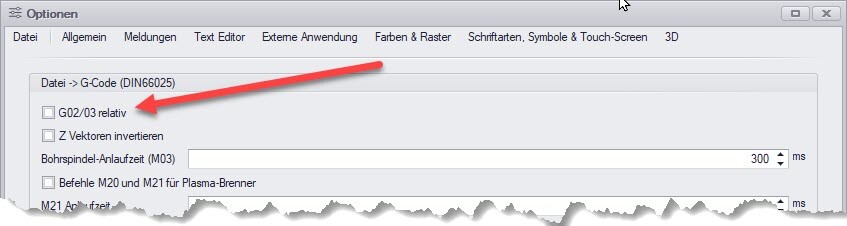
Hinweis: Sollte die geladene G-Code-Datei fehlerhaft dargestellt werden (Kreisbögen werden falsch dargestellt), liegt dies meistens an der Einstellung „G02/03 relativ“. In solchen Fällen sollte die Option „G02/03 relativ“ im Menü „Einstellungen → Optionen → Datei → G-Code“ geändert werden. Dieses Problem tritt auf, weil die Bogenbefehle G02/G03 entweder relativ oder absolut interpretiert werden können. Es gibt keine Möglichkeit automatisch zwischen diesen beiden Modi zu unterscheiden.
For all those who are looking for postprocessors (PP for short) for cncGraF: Below we offer some for download. Please note that these PP's were created by our dedicated user community and kindly provided to us. We cannot guarantee that there are no errors in these PP's. Furthermore, it is not possible for us to provide a PP for all CAD/CAM programmes on the market. There are simply too many CAD/CAM programmes to offer specific support for each one.
As a rule, the right approach is to contact the manufacturer of the CAD/CAM software and ask if they can help you to customise a postprocessor, especially if you are not able to do it yourself.
Download Postprocessor (PP for short) for cncGraF 7.1/8 (ZIP file):
We hope that this blog article has given you an insight into the world of G-code and the importance of post-processors.
Yours sincerely, Your BOENIGK-electronics Team.